Author

admin

Browsing

Surging oil prices continue to ripple through the global economy because of the war with Iran. Now, some analysts say the worst could still be ahead as the conflict drags on.

The concern is that beyond immediate knock-on effects from rising gasoline prices, the war’s disruption could come in waves — ones that will play out over weeks and months and leave few parts of the global economy untouched.

“We haven’t seen the brunt of it yet,” said Samantha Gross, director of energy security and climate at the Brookings Institute. “I feel like markets are so far underestimating the effect of the war. It seems that they expect this war to go quickly, and they expect that we can go back to the world before when it’s over. And I don’t think either of those ideas is true.”

The warning signs are already here. The global oil price benchmark, Brent crude — which heavily influences U.S. gasoline prices — briefly topped $119 a barrel last week, the highest since the war began and a level last seen in July 2022 amid the pandemic-era inflation wave. As of Monday, Brent prices had settled at about $113 a barrel.

The average price of a gallon of gasoline hit $4 Tuesday for the first time since mid-2022, as the cost of oil surges due to the Iran war.

In the month since the United States and Israel attacked Iran, the average price of unleaded gas has spiked more than a dollar a gallon. On Tuesday morning, the average price nationwide was $4.02 per gallon, motor club AAA said.

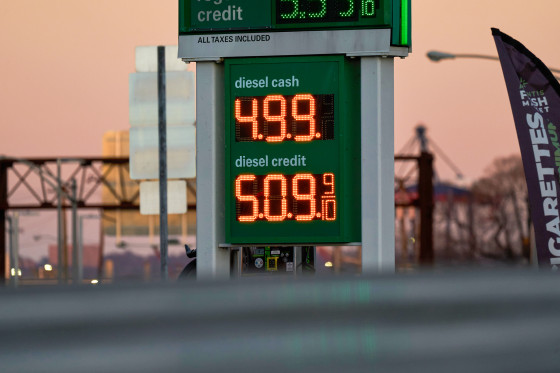
It’s not just retail gasoline. The diesel fuel used to power trucks delivering goods to stores, farm equipment and public transit has risen to $5.45 per gallon, more than $1.80 higher than it was a year ago.

Driving that is the soaring cost of crude oil worldwide. U.S West Texas Intermediate (WTI) crude has risen more than 50% since the war began Feb. 28, while Brent, the international benchmark, has seen a jump of nearly 60%.

On Monday, U.S. crude oil settled above $100 per barrel for the first time since Russia’s full-scale invasion of Ukraine in 2022. Brent crude oil is poised to see its largest one-month increase on record.

Oil prices had already started rising before the Iran war began, fueled by fears that a conflict was imminent. Since the start of the year, the cost of U.S. crude oil is up more than 80% and Brent has skyrocketed almost 90%.

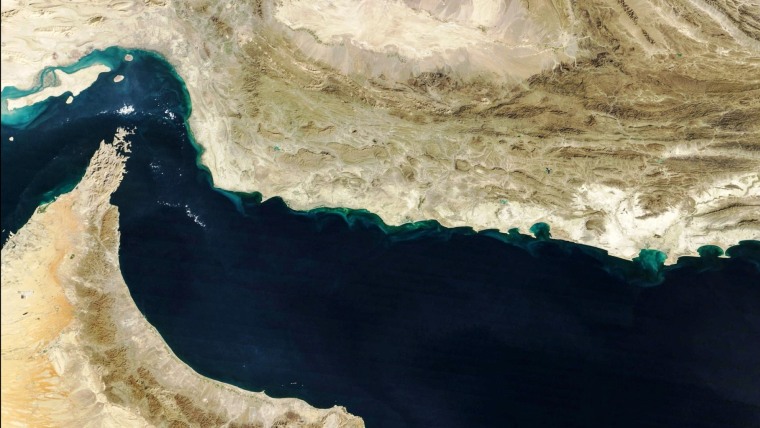
In response to strikes by the U.S. and Israel, Iran has effectively blocked shipping through the Strait of Hormuz, a critical channel off its southern coast. Tehran has also attacked its Gulf Arab neighbors, who are major oil producers.

Typically, more than 20% of the world’s oil supply moves through the waterway. But Iran has repeatedly threatened to attack ships if they move through the strait without permission or if they’re associated with the U.S. or Israel. Several tankers have been hit.

As a result, many tankers are stranded in the Persian Gulf, unable to deliver their products to markets.

Some tankers have been allowed to pass through the strait, including one associated with India and three associated with China. But overall traffic through the waterway is down more than 90% in March.

During the first 28 days of the war, a total of only 55 to 60 tankers have cleared the Strait of Hormuz, according to the ship tracking website TankerTrackers.

Before the war, more than 100 ships per day made the passage, it said.

“This rise in gasoline spending could potentially dampen consumers’ ability to spend on ‘nice-to-have’ or discretionary categories,” Bank of America economists recently wrote.

This year, the average U.S. household will spend an additional $740 on gas because of the jump in oil prices, according to economists from the Stanford Institute for Economic Policy Research.

“The consumer has already seen the sticker shock from rising gasoline prices and increased airline ticket prices from the rising cost of jet fuel,” longtime industry analyst Andy Lipow said. “However, the full effects of the higher diesel prices has yet to be felt and that will flow through the economy over the next few months.”

As American consumers adjust to higher gas prices, oil dependent nations in Europe and Asia are already facing much more severe energy shocks. Inflation, oil and gas rationing and sharp pullbacks in economic growth estimates are impacting billions of people worldwide.

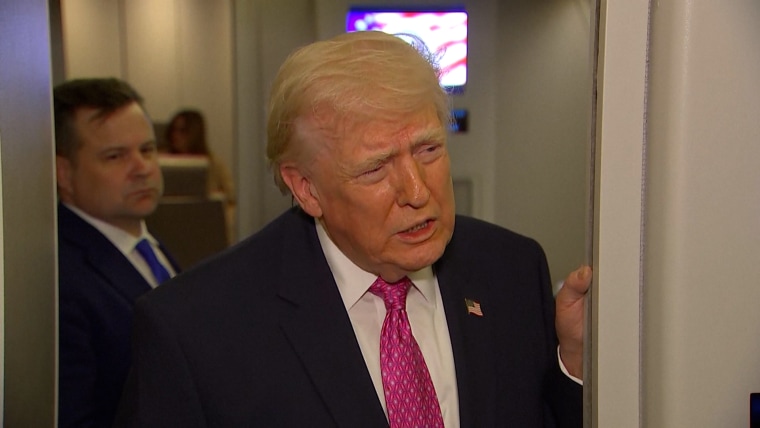
President Donald Trump said Sunday that he would like to “take the oil in Iran” and is considering seizing the export hub of Kharg Island, which is responsible for more than 90% of Iran’s oil exports.

In an interview with the Financial Times, Trump said his “preference would be to take the oil.”

“To be honest with you, my favorite thing is to take the oil in Iran but some stupid people back in the U.S. say: ‘Why are you doing that?’ But they’re stupid people,” he said.

The interview marks some of Trump’s most direct comments about his thinking on what to do with Iran’s oil.

In an interview with NBC News this month, Trump sidestepped answering whether he had plans to try to take Iran’s oil.

“You look at Venezuela,” he said. “People have thought about it, but it’s too soon to talk about that.”

In January, the U.S. captured Venezuelan leader Nicolás Maduro and proceeded to take more control over the country’s oil industry.

The White House did not immediately respond to a request for comment Sunday night.

Trump told the Financial Times on Sunday that the U.S. has “a lot of options,” including potentially taking Kharg Island, a rare island made of hard coral off Iran.

“Maybe we take Kharg Island, maybe we don’t. We have a lot of options,” Trump said. “It would also mean we had to be there [in Kharg Island] for a while.”

Oil prices have skyrocketed around the globe as the war continues, with U.S. crude oil costing over $100 a barrel Sunday.

Thousands more U.S. troops are heading to the Middle East, with the USS Tripoli arriving on Saturday as part of a complement of 3,500 troops. But Trump and his administration continue to signal that they are working to negotiate a 15-point proposal to end the war.

Trump declined Sunday to offer specific details about whether a ceasefire deal could be reached in the coming days to reopen the Strait of Hormuz, a critical waterway used to move about 20% of the world’s oil exports.

“We’ve got about 3,000 targets left — we’ve bombed 13,000 targets — and another couple of thousand targets to go,” Trump said in the Financial Times interview. “A deal could be made fairly quickly.”

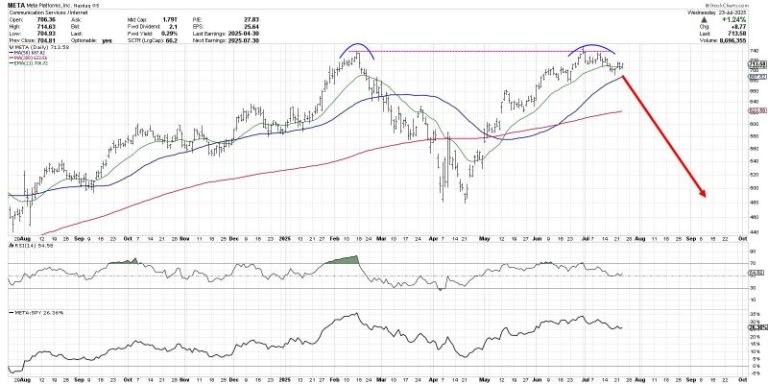
The chart of Meta Platforms, Inc. (META) has completed a roundtrip from the February high around $740 to the April low at $480 and all the way back again.  Over the last couple weeks, META has now pulled back from its retest of all-time highs, leaving investors to wonder what may come next.

Is this the beginning of a new downtrend phase for META?  Or just a brief pullback before a new uptrend phase propels META to new all-time highs?

Today we’ll look at two potential scenarios, including the double top pattern and the cup and handle pattern, and share which technical indicators and approaches could help us determine which path plays out into August.

The double top scenario basically means that the late July retest of the previous all-time high was the end of the recent uptrend phase.  The double top pattern is literally when a major resistance level is set and then retested.  The implication is that a lack of willing buyers means the uptrend is exhausted, and there is nowhere to go but down.

While the 21-day exponential moving average is currently in play for META, I would say that a break below the 50-day moving average could confirm this as the correct scenario.  If that smoothing mechanism does not hold, then the price action would imply less of a pullback and more like the beginning of a real distribution phase.

What is META pulls back but then resumes an uptrend phase, leading META to another new all-time high?  That would result in a confirmed cup and handle pattern, created by a large rounded bottoming pattern followed by a brief pullback.  The key to this pattern is the “rim” of the cup, which sits right at $740 for META.

Given the pullback META has demonstrated so far in July, I would say that a break above the $740 level would basically confirm a bullish cup and handle pattern.  That would suggest much more upside potential for META, as the stock would literally go into previously uncharted territory.

So how can we determine which scenario is more likely to play out?  This is where we need to incorporate more technical indicators into the discussion, as a way to further validate and confirm our investment thesis.

Just to review, I think a break above $740 would confirm a bullish cup and handle pattern.  I would also say that a break below the $680 level, which would represent a move below the 50-day moving average as well as the June swing lows, would basically confirm a bearish double top pattern.

We can also use the Relative Strength Index (RSI) to help determine whether META remains in a bullish trend phase.  During bull phases, the RSI rarely gets below 40, because buyers usually step in to “buy the dips” and keep the momentum fairly constructive.  So if the price would break down, and the RSI would not hold that crucial 40 level, that could mean a bearish outlook is warranted.

Finally, we can use volume-based indicators to assess whether moves in the price are supported by stronger volume readings.  Here I’ve included the Accumulation/Distribution Line, which tracks the trend in daily volume readings over time.  We can see that the high in July resulted in a divergence, as the A/D line was trending lower.  If the A/D line would break below its June and July lows, marked by a dashed red line, that would represent a bearish volume reading for META.

Technical analysis is less about predicting the future, and more about determining the most probable scenarios based on our analysis of trend, momentum, and volume.  I hope this discussion shows how the outlook for META can be easily determined and tracked using the best practices of technical analysis!

RR#6,

Dave

PS- Ready to upgrade your investment process?  Check out my free behavioral investing course!

David Keller, CMT

President and Chief Strategist

Sierra Alpha Research LLC

marketmisbehavior.com

https://www.youtube.com/c/MarketMisbehavior

Disclaimer: This blog is for educational purposes only and should not be construed as financial advice.  The ideas and strategies should never be used without first assessing your own personal and financial situation, or without consulting a financial professional.  

The author does not have a position in mentioned securities at the time of publication.    Any opinions expressed herein are solely those of the author and do not in any way represent the views or opinions of any other person or entity.

Markets don’t usually hit record highs, risk falling into bearish territory, and spring back to new highs within six months. But that’s what happened in 2025.

In this special mid-year recap, Grayson Roze sits down with David Keller, CMT, to show how disciplined routines, price-based signals, and a calm process helped them ride the whipsaw instead of getting tossed by it. You’ll see what really happened under the surface, how investor psychology drove the swings, and the exact StockCharts tools they leaned on to stay objective. 

If you’re focused on protecting capital, generating income, and sleeping well at night while still capturing the upside, this is a must-watch. Discover which charts deserve your attention now, what to ignore, and how to prep for the back half of 2025. 

This video premiered on July 23, 2025. Click on the above image to watch on our dedicated Grayson Roze page on StockCharts TV.

You can view previously recorded videos from Grayson at this link.

(TheNewswire)

Brossard, Quebec TheNewswire – le 12 mars 2026 CORPORATION Charbone (TSXV: CH,OTC:CHHYF; OTCQB: CHHYF; FSE: K47) (« Charbone » ou la « Société »), un producteur et distributeur nord-américain spécialisé dans l’hydrogène propre Ultra Haute Pureté (« UHP ») et les gaz industriels stratégiques, est heureuse d’annoncer sa participation à la conférence Hydrogen East du 13 avril 2026, ainsi que le développement d’un hub d’approvisionnement dédié à l’hydrogène UHP et aux gaz de spécialité stratégiques dans le marché du Canada Atlantique (« Hub Atlantique »).

Cette initiative marque une nouvelle étape dans la stratégie de déploiement de Charbone visant à établir un réseau intégré de hubs de production, stockage et distribution d’hydrogène et de gaz industriels stratégiques en Amérique du Nord.

Le futur Hub Atlantique qui sera géré par sa filiale Charbone Nouvelle-Écosse Inc. et opérationnel d’ici juin 2026, servira d’installation physique dédiée au stockage local et à la distribution régionale, permettant d’assurer un approvisionnement fiable et flexible en hydrogène pour une variété d’utilisateurs industriels exigeants, incluant les secteurs de la défense, de la fabrication avancée, de la mobilité et des infrastructures énergétiques.

Charbone est active dans la région de l’Atlantique depuis plus de trois (3) années et a développé une connaissance approfondie des marchés de la Nouvelle-Écosse, du Nouveau-Brunswick et de l’Île-du-Prince-Édouard, tout en travaillant sur différentes initiatives avec des clients et partenaires potentiels d’envergure, notamment dans les domaines suivants :

  • infrastructures portuaires 

  • chantiers navals et installations de la Marine canadienne 

  • chaîne d’approvisionnement de composantes automobiles 

  • entreprises de services publics et énergétiques 

  • entreprises de recherche et développement 

  • solutions de transport avancées à éro émission 

Ce modèle « hub-and-spoke » constitue un pilier de la stratégie de Charbone visant à déployer progressivement un réseau évolutif de hubs d’approvisionnement en hydrogène et en gaz industriels stratégiques à travers le Canada et les États-Unis, permettant de soutenir les marchés régionaux grâce à des capacités locales de stockage, de logistique et de distribution.

« La région du Canada Atlantique représente un marché stratégique pour Charbone, notamment en raison de la présence d’infrastructures de grandes qualités, d’utilisateurs industriels d’envergures et d’initiatives de transition énergétique, » a déclaré Dave B. Gagnon, PDG de Charbone. La Société prévoit que ce hub jouera un rôle structurant dans le développement de sa future plateforme logistique nord-américaine de l’hydrogène. »

Pour plus de détails sur la Conférence Hydrogen East, veuillez cliquer sur le lien ci-bas :

À propos de CORPORATION Charbone

Charbone est un développeur et producteur d’hydrogène propre Ultra Haute Pureté (UHP) doté d’une plateforme de distribution de gaz industriels en pleine expansion. Grâce à une approche modulaire, Charbone se concentre sur le développement d’un réseau d’usines de production d’hydrogène propre en Amérique du Nord et sur certains marchés à l’étranger, en commençant par son projet phare de Sorel-Tracy au Québec. Le modèle intégré de l’entreprise réduit les risques, améliore l’évolutivité et permet de diversifier ses sources de revenus grâce à des partenariats dans le domaine de l’hélium et d’autres gaz de spécialités. Charbone s’engage à soutenir la transition mondiale vers une économie bas carbone en fournissant des solutions d’hydrogène propre et de gaz de spécialités accessibles et décentralisées, tout en soutenant les clients industriels mal desservis en gaz et en accélérant la transition vers une énergie propre locale. Charbone est coté sur la bourse de croissance TSX (TSXV: CH,OTC:CHHYF); sur les marchés OTC (OTCQB: CHHYF); et à la Bourse de Francfort (FSE: K47). Pour plus d’informations, veuillez visiter www.charbone.com.

Énoncés prospectifs

Le présent communiqué de presse contient des énoncés qui constituent de « l’information prospective » au sens des lois canadiennes sur les valeurs mobilières (« déclarations prospectives »). Ces déclarations prospectives sont souvent identifiées par des mots tels que « a l’intention », « anticipe », « s’attend à », « croit », « planifie », « probable », ou des mots similaires. Les déclarations prospectives reflètent les attentes, estimations ou projections respectives de la direction de Charbone concernant les résultats ou événements futurs, sur la base des opinions, hypothèses et estimations considérées comme raisonnables par la direction à la date à laquelle les déclarations sont faites. Bien que Charbone estime que les attentes exprimées dans les déclarations prospectives sont raisonnables, les déclarations prospectives comportent des risques et des incertitudes, et il ne faut pas se fier indûment aux déclarations prospectives, car des facteurs inconnus ou imprévisibles pourraient faire en sorte que les résultats réels soient sensiblement différents de ceux exprimés dans les déclarations prospectives. Des risques et des incertitudes liés aux activités de Charbone peuvent avoir une incidence sur les déclarations prospectives. Ces risques, incertitudes et hypothèses comprennent, sans s’y limiter, ceux décrits à la rubrique « Facteurs de risque » dans le rapport de gestion de la Société pour la période terminée le 30 septembre 2025, qui peut être consultée sur SEDAR+ à l’adresse www.sedarplus.ca; ils pourraient faire en sorte que les événements ou les résultats réels diffèrent sensiblement de ceux prévus dans les déclarations prospectives.

Sauf si les lois sur les valeurs mobilières applicables l’exigent, Charbone ne s’engage pas à mettre à jour ni à réviser les déclarations prospectives.

Ni la Bourse de croissance TSX ni son fournisseur de services de réglementation (tel que ce terme est défini dans les politiques de la Bourse de croissance TSX) n’acceptent de responsabilité quant à la pertinence ou à l’exactitude du présent communiqué.


Contact Corporation Charbone

Téléphone: +1 450 678 7171

Courriel: ir@Charbone.com

Benoit Veilleux

Chef de la direction financière et secrétaire corporatif


Copyright (c) 2026 TheNewswire – All rights reserved.

News Provided by TheNewsWire via QuoteMedia

This post appeared first on investingnews.com

The S&P 500 ($SPX) just logged its fifth straight trading box breakout, which means that, of the five trading ranges the index has experienced since the April lows, all have been resolved to the upside.

How much longer can this last? That’s been the biggest question since the massive April 9 rally. Instead of assuming the market is due to roll over, it’s been more productive to track price action and watch for potential changes along the way. So far, drawdowns have been minimal, and breakouts keep occurring. Nothing in the price action hints at a lasting change — yet.

While some are calling this rally “historic,” we have a recent precedent. Recall that from late 2023 through early 2024, the index had a strong start and gave way to a consistent, steady trend.

From late October 2023 through March 2024, the S&P 500 logged seven consecutive trading box breakouts. That streak finally paused with a pullback from late March to early April, which, as we now know, was only a temporary hiccup. Once the bid returned, the S&P 500 went right back to carving new boxes and climbing higher.

New 52-Week Highs Finally Picking Up

If there’s been one gripe about this rally, it’s that the number of new highs within the index has lagged. As we’ve discussed before, among all the internal breadth indicators available, new highs almost always lag — that’s normal. What we really want to see is whether the number of new highs begins to exceed prior peaks as the market continues to rise, which it has, as shown by the blue line in the chart below.

As of Wednesday’s close, 100 S&P 500 stocks were either at new 52-week highs or within 3% of them. That’s a strong base. We expect this number to continue rising as the market climbs, especially if positive earnings reactions persist across sectors.

Even when we get that first day with 100+ S&P 500 stocks making new 52-week highs, though, it might not be the best time to initiate new longs.

The above chart shows that much needs to align for that many stocks to peak in unison, which has historically led to at least a short-term consolidation, if not deeper pullbacks — as highlighted in yellow. Every time is different, of course, but this is something to keep an eye on in the coming weeks.

Trend Check: GoNoGo Still “Go”

The GoNoGo Trend remains in bullish mode, with the recent countertrend signals having yet to trigger a greater pullback.

Active Bullish Patterns

We still have two live bullish upside targets of 6,555 and 6,745, which could be with us for a while going forward. For the S&P 500 to get there, it will need to form new, smaller versions of the trading boxes.

Failed Bearish Patterns

In the chart below, you can view a rising wedge pattern on the recent price action, the third since April. The prior two wedges broke down briefly and did not lead to a major downturn. The largest pullbacks in each case occurred after the S&P 500 dipped below the lower trendline of the pattern.

The deepest drawdown so far is 3.5%, which is not exactly a game-changer. Without downside follow-through, a classic bearish pattern simply can’t be formed, let alone be broken down from.

We’ll continue to monitor these formations as they develop because, at some point, that will change.

Is the market’s next surge already underway? Find out with Tom Bowley’s breakdown of where the money is flowing now and how you can get in front of it.

In this video, Tom covers key moves in the major indexes, revealing strength in transports, small caps, and home construction. He identifies industry rotation signals, which are pointing to aluminum, recreational products, and furnishings. Tom then demonstrates how to use StockCharts’ tools to scan for momentum stocks in emerging leadership groups — see why SGI tops Tom’s list. He ends with a discussion of post-earnings reactions from major names like GOOGL, TSLA, IBM, and LVS. 

And, of course, Tom wraps every idea with clear chart setups you can act on today. 

This video premiered on July 24, 2025. Click this link to watch on Tom’s dedicated page.

Missed a session? Archived videos from Tom are available at this link.

Here are some charts that reflect our areas of focus this week at


XLU Leads with New High

Even though the Utilities SPDR (XLU) cannot keep pace with the Technology SPDR (XLK) and Communication Services SPDR (XLC), it is in a leading uptrend. XLU formed a cup-with-handle from November to July and broke to new highs the last two weeks. ETFs hitting new highs are in strong uptrends and should be on our radar.


Metal Mania in 2025

In a tribute to Ozzy, metals are leading the way higher in 2025. The PerfChart below shows year-to-date performance for the continuous futures for 12 commodities. Copper, Platinum and Palladium are up more than 45% year-to-date, while Gold is up 28.38% and Silver is up 35.30%. QQQ is up 10.52% year-to-date, but lagging these metals. The other commodities are mixed.


Multi-Year Highs for Silver and Copper

The next chart shows 11 year bar charts for five metals. Gold broke out in early 2024 and led the metals move with an advance the last 21 months. Silver and copper broke out to multi-year highs. Platinum broke above its 2021 high and Palladium got in the action with an 18 month high. There is a clear message here: metals are moving higher and leading as a group.  


Home Construction Hits Moment of Truth

The Home Construction ETF (ITB) hit its moment of truth as it rose to its falling 40-week SMA. Notice that ITB failed just below this moving average in August 2023. During the 2023-2024 uptrend, the 40-week SMA was more friendly as ITB reversed near this level in October 2023 and June 2024. ITB surged to the falling 40-week SMA in July, but the long-term trend is down and this area could be its nemesis.

Thanks for Tuning in!

See TrendInvestorPro.com for more


Tartisan Nickel Corp. (CSE: TN,OTC:TTSRF) (OTCQX: TTSRF) (FSE: 8TA) (‘Tartisan’, or the ‘Company’) is pleased to provide an update on the Phase 1 diamond drill program at the Company’s Kenbridge Nickel-Copper-Cobalt Project, Sioux Narrows, Northwestern Ontario. The Phase 1 drill program was designed to test the on strike and down dip potential for additional nickel sulphide mineralization to enhance the size and grade of the Kenbridge Deposit.

A total of 3,191m of drilling has been completed to date. The first 4 drill targets have been completed (drill holes KB26-207, KB26-208, KB26-209 and KB26-210 outlined on Figure 1). Samples were delivered to AGAT Labs in Thunder Bay for analysis.

Reported in this release are the results from the 4th hole KB26-210. Results from the hole confirm both A and B zones were intersected as outlined in the Table 1 below. Zone A was intersected from 762.4 to 787.0m drill depth and returned 0.71% Ni, 0.56% Cu over 24.6 metres including 6.1m of 1.17% Ni, 1.45% Cu from 762.4 to 768.5m drill depth and 2.0 m of 1.73% Ni, 0.31% Cu from 774.5 to 776.5m drill depth. Zone B was intersected from 800.2m to 806.0m drill depth. Results were 0.27% Ni, 0.24% Cu over 5.8 metres. Drill core intersection widths are estimated to be between 65 and 80% true width.

Fig 1: Long section of Kenbridge deposit showing drilling targets. Completed or holes in progress are outlined in red circles.

To view an enhanced version of this graphic, please visit:
https://images.newsfilecorp.com/files/1492/288216_d63210af3456385c_002full.jpg

Mark Appleby, CEO of Tartisan Nickel Corp., stated, ‘The KB26-210-hole result represents a significant high-grade intercept. We are very encouraged to see the wider intersection as the deposit appears to now flare outwards at depth. Intersecting 24.6 metres of 0.71% Ni and 0.56% Cu including higher grade portions (1.17% Ni, 1.45% Cu over 6.1m and 1.73% Ni, 0.31% Cu over 2.0m) confirms continuity of significant nickel-copper mineralization in this system. These results will strengthen our ability and confidence in upgrading our resource and in the project’s overall potential. While we have now taken a brief pause for spring break up, the company will introduce Borehole EM down the drill holes completed in Phase 1 and commence Phase 2 drilling this spring. We look forward to drilling below the existing shaft bottom to test for the depth extension to the deposit shortly.’

Table 1: Highlight intervals (* denotes hole reported in this release)

To view an enhanced version of this graphic, please visit:
https://images.newsfilecorp.com/files/1492/288216_table1.jpg

The Kenbridge Property is in the Kenora Mining District, Sioux Narrows, Ontario, Canada with all-season road access. The Kenbridge Deposit has an existing shaft to a depth of 2,042 ft (622 m), with level stations at 150 ft. (45 m) intervals below the shaft collar and two levels developed at 350 ft (107 m) and 500 ft (152 m) below the shaft collar.

Surveyed Hole Locations (Coordinates in UTM zone 15)

To view an enhanced version of this graphic, please visit:
https://images.newsfilecorp.com/files/1492/288216_table2.jpg

Qualified Person

The technical information in this news release has been prepared in accordance with Canadian regulatory requirements as set out in NI 43-101 and reviewed and approved by Dean MacEachern, P. Geo., an Independent Consultant to the Company and a Qualified Person as defined by NI 43-101.

QA/QC

Sample QA/QC procedures for Tartisan have been designed to meet or exceed industry standards. Drill core is collected from the diamond drill and placed in sealed core trays for transport to on-site sampling and core cutting facilities. The core is logged and samples taken from 0.3m to a maximum sample length of 1.5m. The core samples are split with a diamond blade saw with continuous running water, half of the sample is sent for lab testing, and the remaining half core is left in the core box for record or further sampling. The core samples are bagged in heavy plastic bags with 6 samples being placed into a rice bag for transport to AGAT Laboratories in Thunder Bay, ON or Calgary, AB for assay. Samples are submitted in batches of 50. 100g blind certified reference materials (CRMs) from CDN Resources, as well as, duplicates and blank samples are systematically inserted by the Company into the sample stream with reference to the mineralization in the sampled rock and analyzed as part of the Company’s quality assurance/quality control protocol, as well, AGAT labs implements their own quality control testing by inserting their own CRMs and Blanks in the sample stream for accredited testing.

All drill core samples were prepped and analyzed at AGAT Laboratories in Thunder Bay, Ontario or shipped to Calgary for testing. An ISO/IEC 17025 2017 certified independent laboratory from organizations like the Standards Council of Canada (SCC), the Canadian Association for Laboratory Accreditation (CALA), ANSI National Accreditation Board (ANAB) and the American Association of Laboratory Accreditation (A2LA). They maintain accreditations across their facilities in Alberta, Saskatchewan, Ontario, Nova Scotia, Newfoundland, Quebec and internationally.

NQ-diameter sawed half-core samples from the drilling program were securely sent by Tartisan Nickel Corp’s geologists to AGAT Laboratories Ltd. (AGAT), with sample preparation in Thunder Bay, Ontario, and analysis in Thunder Bay, Ontario & Calgary, Alberta. Samples were processed for Au, Pt and Pd analysis by 50-gram fire assay with ICP-OES finish and for four acid digestion, multi-element analysis by inductively coupled plasma & mass spectrometry (ICP OES + MS). AGAT sample preparation and laboratory analysis procedures conform to requirements of ISO/IEC Standard 17025 guidelines and meet the requirements under NI 43-101 and CIM best practice guidelines. AGAT Laboratories is independent of Tartisan Nickel Corp.

Samples were dried and crushed to 2 mm, from which a 250 g sub-sample split was then pulverized to 85% passing a 75 micron sieve. Following preparation, assays were determined by the ICP OES method. A 0.25 g aliquot of the prepared pulp was digested in a 4-acid solution consisting of hydrochloric, nitric, perchloric and hydrofluoric acids. 4-acid is a near total digest and only the most highly resistant minerals are not dissolved. The resulting solution was analyzed via ICP-MS and ICP-ES for 8 elements and was corrected for inter-element spectral interferences. Lower detection limits for this procedure are 0.01 ppm for nickel, 0.01 ppm for copper, 0.01 ppm for cobalt, 0.01 ppm for platinum, 0.01 ppm palladium, 0.01 ppm silver and 0.01 ppm for gold.

Samples with initial results beyond the upper detection limit of the ICP OES method were analyzed by (201-071) 4 acid digest – Metals Package, ICP-OES/ICP-MS finish (CGY). The thresholds are >1% for nickel, copper and cobalt. AGAT Laboratories employs internal quality control standards, duplicates and blank samples at set frequencies. Tartisan Nickel Corp. stores all its drilled core on-site and takes pride in its facilities and strives for excellence in its QA/QC procedures.

About Tartisan Nickel Corp.

Tartisan Nickel Corp. is a Canadian-based critical minerals exploration and development company which owns, the Kenbridge Nickel-Copper Project near Sioux Narrows, Northwestern Ontario, the Sill Lake Silver Project near Sault Ste. Marie, Ontario as well as the Night Danger Turtle Pond Project near Dryden, Ontario.

Tartisan Nickel Corp. common shares are listed on the Canadian Securities Exchange (CSE: TN,OTC:TTSRF) (OTCQX: TTSRF) (FSE: 8TA). Currently, there are 152,215,641 shares issued and outstanding (156,287,356 fully diluted).

For further information, please contact Mark Appleby, President & CEO, and a Director of the Company, at 416-804-0280 (info@tartisannickel.com). Additional information about Tartisan Nickel Corp. can be found at the Company’s website at www.tartisannickel.com or on SEDAR+ at www.sedarplus.ca.

This news release may contain forward-looking statements including but not limited to comments regarding the timing and content of upcoming work programs, geological interpretations, receipt of property titles, potential mineral recovery processes, etc. Forward-looking statements address future events and conditions and therefore involve inherent risks and uncertainties. Actual results may differ materially from those currently anticipated in such statements.

The Canadian Securities Exchange (operated by CNSX Markets Inc.) has neither approved nor disapproved of the contents of this press release.

To view the source version of this press release, please visit https://www.newsfilecorp.com/release/288216
News Provided by TMX Newsfile via QuoteMedia

This post appeared first on investingnews.com